

My wife and I are coming to the end of a 2-week holiday in Trinidad & Tobago. We’ve been staying with friends: a lovely local family who’ve given us the special Trini’s tour of the main island and its smaller cousin Tobago.
If you ever find yourself stepping off a plane into Trinidad’s tropical heat, when immigration pull you aside, just tell them you know Michael and Kathleen. With a knowing nod and a wink, the uniformed folk behind the plexiglass screens will wave you through with barely a glance at your out-of-date passports. And outside arrivals, a cortege of official cars with nice blue flashing lights will escort you to your hotel where you’ll be treated like royalty. Honest.
The Birds. They’re Everywhere!
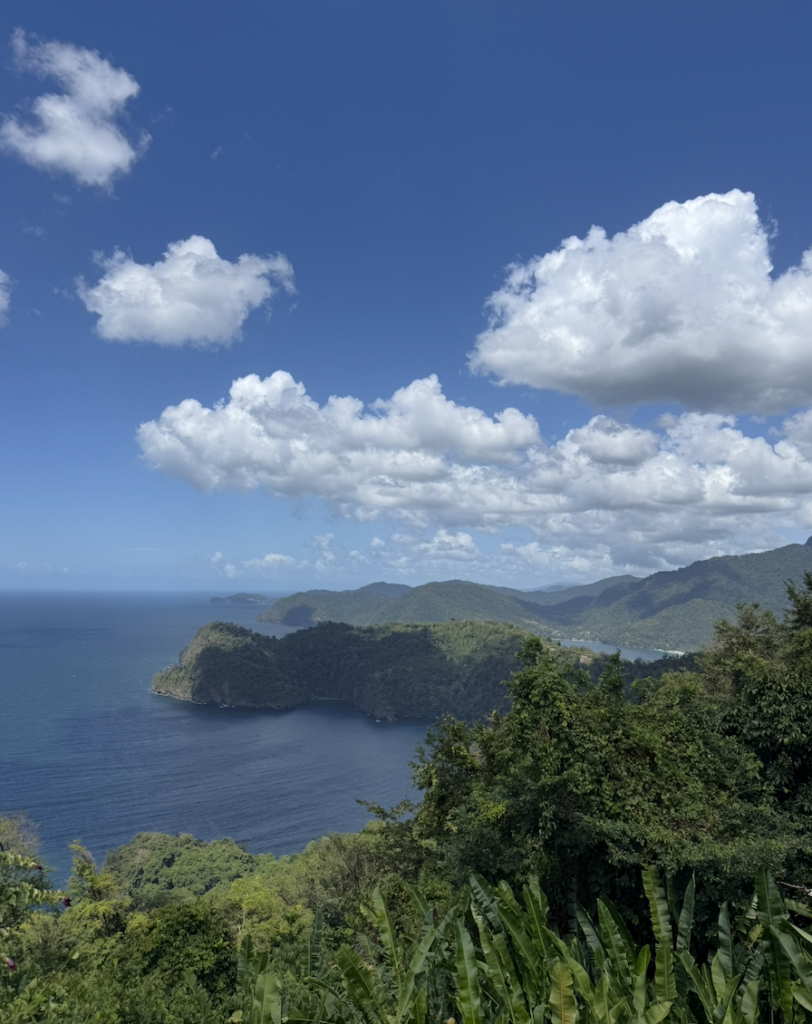
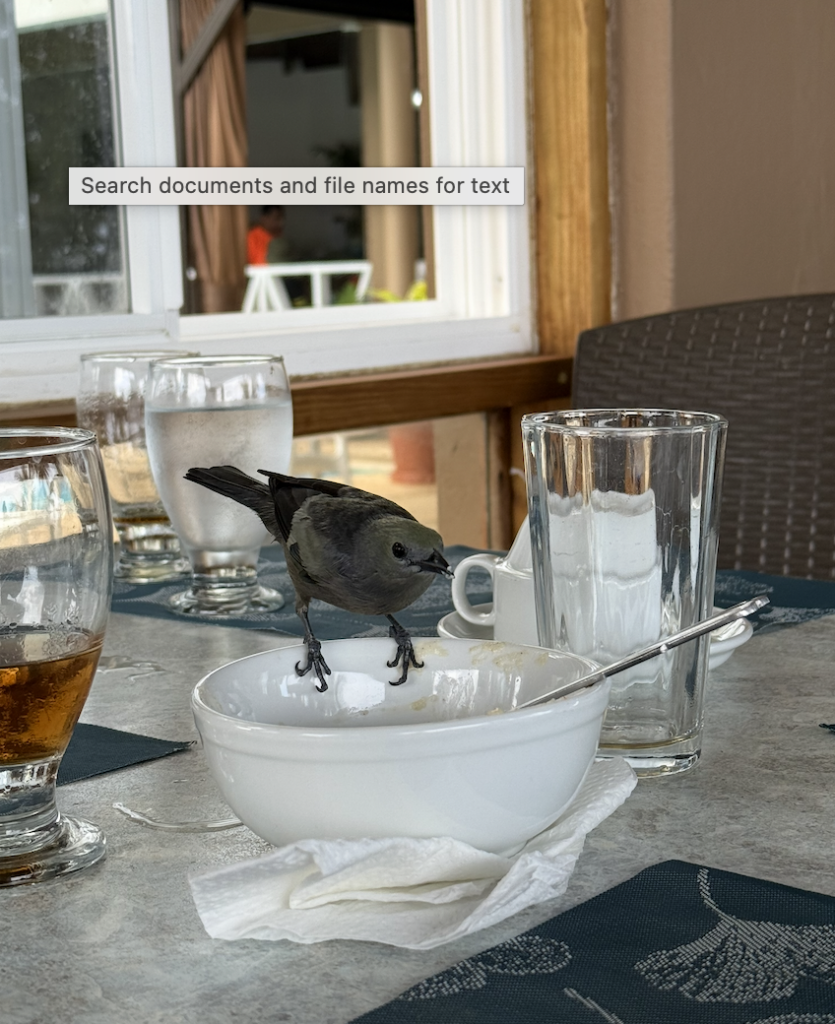
Joking aside, it’s been a treat to explore T&T because I’m a closet bird watcher. I keep that side of me buried to avoid embarrassing close family, but when I read about the 499 bird species that call the islands home, I got very excited mildly interested. Two weeks later, I’ve ticked off 56 species1, a pathetic 11.2% of the total. I’ve seen all sorts, from the tiny, hyperactive yellow bellied BananaQuit to the glorious Channel Billed Toucan. I may have padded the list slightly by including the ubiquitous feral chickens and the odd sparrow but they’re both legit local species. As the warm vacation days have passed and I’ve run out of common species, my spotting rate has declined; my estimated completion date for bagging all 499 is now June 2096, by which point I’ll be 133.
But that’s not where I’m going with this piece. I want to talk nasty, oozing pitch lakes and -in part 2- bubbling, festering mud volcanoes.
Tar Very Much
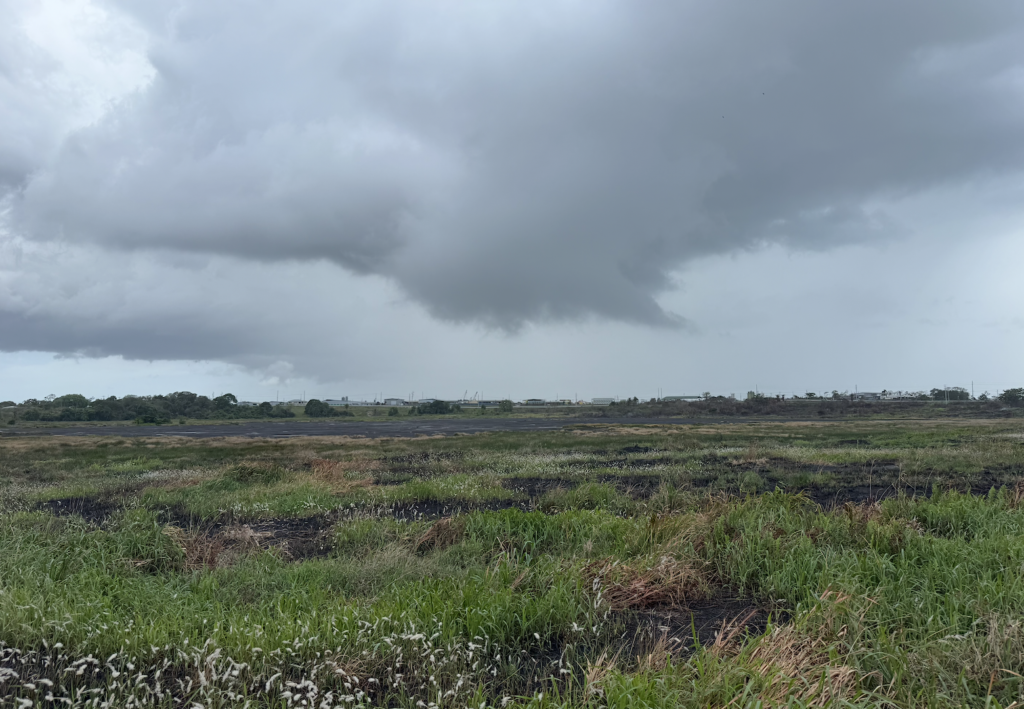
Shortly after we arrived, our hosts took us south to visit the La Brea pitch lake*. It didn’t disappoint. Covering 44 hectares (109 acres) and about 80m deep, it’s huge -the size of 10 Wembley Stadiums; in fact, it’s the biggest in the world (a dubious honour), containing an estimated 10 million tonnes of black pitch which is being mined at about 200 tonnes of asphalt per day. The lake still manages to refill itself and any hole rapidly fills up with nasty black tar, roughly the same consistency as molasses (click on the link to see it in all its sticky glory.)
The whole La Brea neighborhood is underlain by the stuff because it still bubbles up in gardens, in the middle of the road and in basements -pretty much anywhere it can ooze out. Many of the local houses are leaning at jaunty angles as their foundations slowly subside into it.
*Apparently every pitch lake of consequence is named La Brea which is Spanish for “the tar”. There’s a more famous version in downtown Los Angeles that’s coughed up the skeletons of thousands of ice age beasts complete with all manner of tusks, fangs and claws. They’ve found over 3,000 dire wolf skeletons in that lake, and 400 of their skulls are on permanent display at the impressive museum there (all of which suggests the ice age fauna wasn’t that smart and liked the smell of a good coal tar shampoo). Source: https://tarpits.org/stories/dire-wolf-skull-wall-reinstall
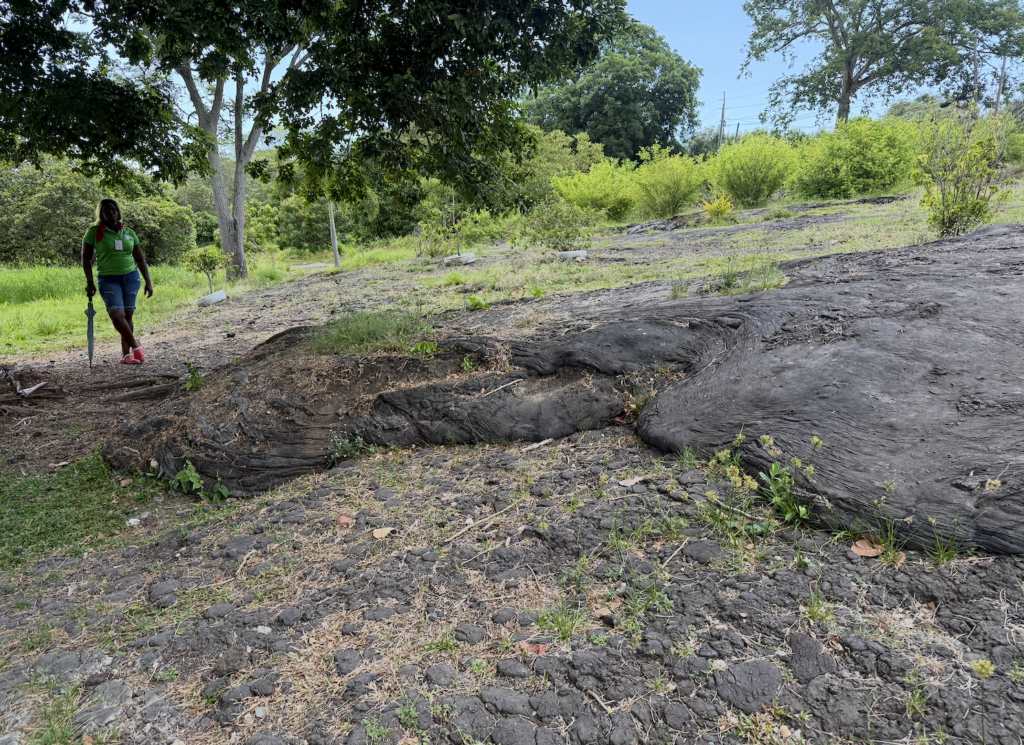
Trinidad is the largest oil producer in the Caribbean. The first production was onshore from the pitch lake area and production gradually expanded with time until the offshore fields were discovered in the 1950s. Today, close to 70% of their oil comes from offshore production rigs but some of it still finds its own way to the surface, forming the La Brea lake.
Blame the Spanish
The first Europeans to clap their greedy eyes on La Brea were Sir Walther Raleigh and his swarthy crew back in 1595. They were looking for gold (as usual) and trying to cause as much trouble as they could for the evil Spanish. Sailing around the south coast of Trinidad that year, the crew smelled tar, pulled ashore, and were eventually taken to see an enormous black lake by the local Carib people (insert cheesy joke about black gold here. Ed.)

Rather than listing a junior petroleum company and raising a wad of seed finance for a quick pump-and-dump marketing campaign, Raleigh’s men foolishly used the tar to caulk the hulls of their ships thus preventing deadly leaks. A few days later they sailed north and captured the nearby Spanish garrison at Puerto de España -modern day Port of Spain- and killed the 50 Spaniards they found there which might seem a tad aggressive by modern community relations standards.
Fast forward to 1887 and Mr. Amzi Barber, known as the “Asphalt King”, secured a 42-year production concession for the lake from the British. He mined shipload after oily shipload and exported it all over the world; including to New York City and Washington DC to seal America’s important roads, and to the British royal family in London who paved Buckingham Palace’s enormous parade ground / forecourt with it.
It’s Hot and It Stinks
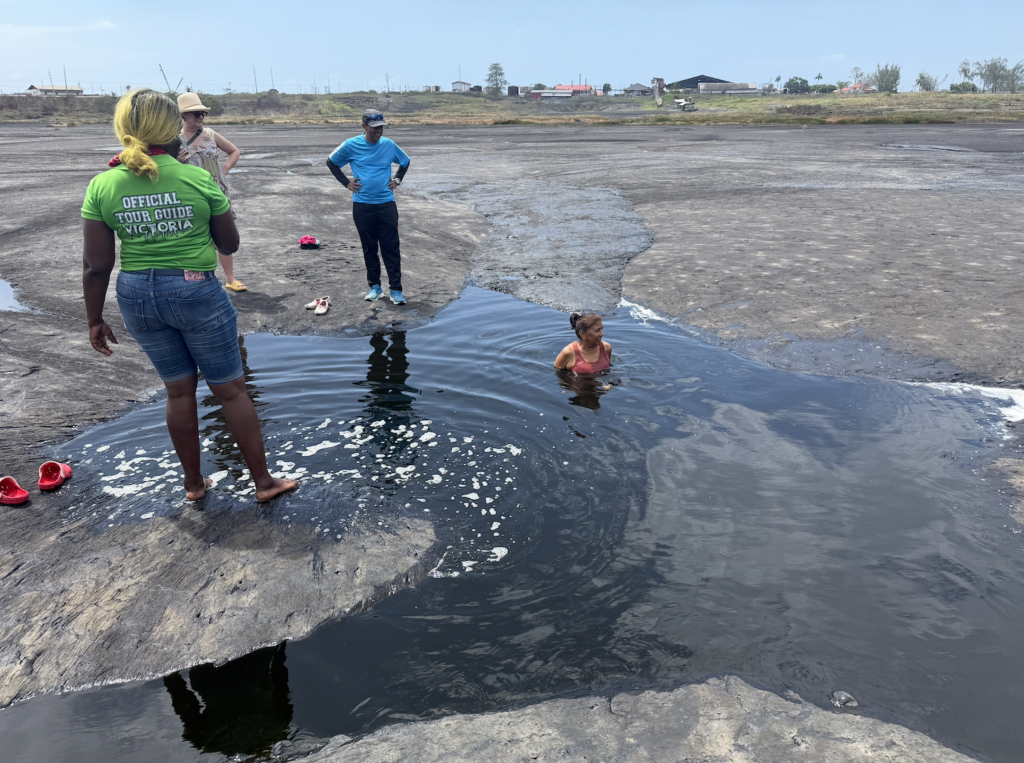
One hot afternoon last week, we marched out onto the lake with a guide, a helpful local woman in a bright, official looking green T-shirt. Walking on natural tar is a weird feeling – soft underfoot- with some really squishy areas where the guide made us take our shoes off to experience the full black ooze kinky foot massage effect.
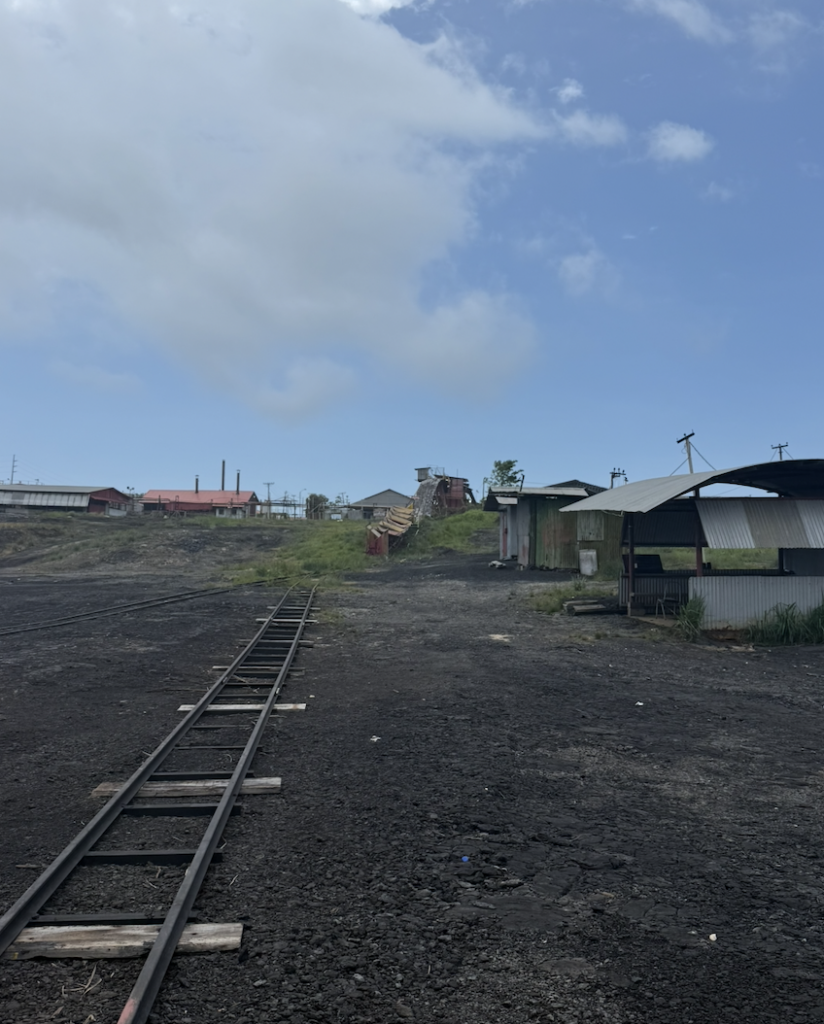
We walked gingerly past the modern production area; a ramshackle collection of huts, sheds and buggered rail lines owned by Lake Asphalt of Trinidad & Tobago. Google’s AI tells me they’re still in production, but the condition of their equipment doesn’t appear to support that. They also purport to employ 200 people but most of them must have been skiving off the day we were there.
It’s A Horrible Death
In the middle of the pond, the smell is a heady mix of road resurfacing works and old gas station forecourt minus the ice machine. Baking in the blazing sun, and slightly headachy from the fumes, our guide warned us not to fall through the leathery black crust into the molten tar below. “DO NOT STEP ON THOSE BITS” she said in a loud voice pointing to some wrinkly, tarry bits that looked like the wrinkly, tarry ones we’d just walked on to get there.
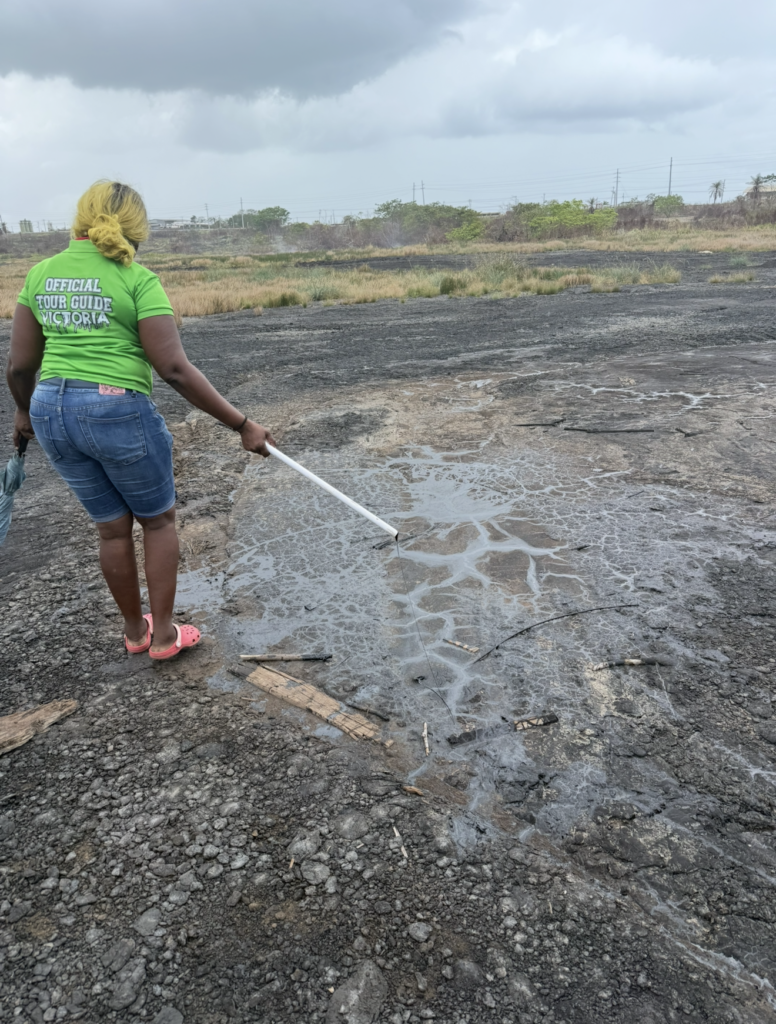
The last tourist who had walked on the dodgy bits, she said, ended up neck deep in warm tar which promptly hardened in the sun when they were pulled out of the goo. The caring ER staff at the local hospital tried to remove the baked-on oil but as it came off it took the victim’s skin with it, killing them. But I imagine the cremation went well.
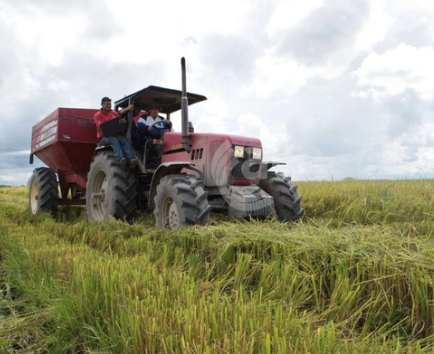
She did a great job describing the lake’s history to us, but the narrative went a little off the rails when she got on to the geology. According to her, La Brea is connected to a similar site roughly 70km away in Venezuela via a network of large subterranean fractures. When the Venezuelans recently lost a tractor into the oily depths of their lake, she claimed it re-emerged a few months later at La Brea and started up at the first turn of the ignition key.
It’s Not Very Fertile
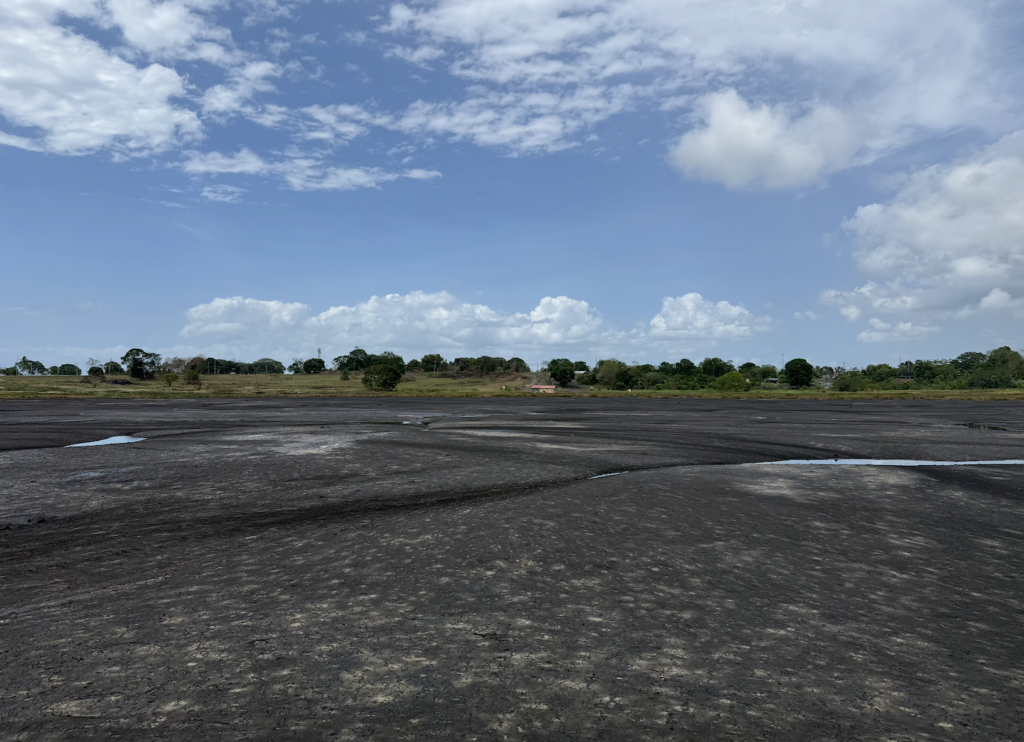
Unsurprisingly, given that solid tar doesn’t make a good soil, very little grows on the lake other than extremophile microbes that eat hydrocarbons and some ratty rushes here and there. It does hold water quite nicely and from a distance the surface of the lake appears dotted with attractive-looking iridescent ponds with hydrocarbon films on their surface.
After heavy rains, the ponds join up to form a large swimmable body of water, but when we got there at the end of a dry spell, it wasn’t so pretty. The swimming lake was gone and in its place were small, isolated puddles that came in a variety of deeply unattractive colours. Some were filled with an evil brown, sump-oil coloured liquid and others with a nasty looking hydrogen sulphide-enriched miasma that was a vile shade of olive green and smelled of bad eggs. Our guide suggested that we might like to swim in them (not a bloody chance, thought I) and she started to talk up the skin-cleansing properties of the “water” to my wife and Kathleen who immediately stripped off to their bathing suits and slithered into 10 inches of warm sump oil.
“Think how much younger you’ll look after a quick dip.” Said the guide, looking pointedly at Micheal and I standing resolutely on the sidelines.
“I’m good” I replied. “I’ll just watch. Someone needs to call the ambulance and book the skin grafts.” which was perhaps not the wisest choice of words.
There’s Guides and Guides
Strangely, the womenfolk survived and we eventually set off back for the safety of the shore, followed as we walked by a local drunk masquerading as a tour guide. He’d appeared from the scabby rushes as if by magic and was wearing a filthy T shirt with the word “guide” across his sweat stained back. From his tone he obviously thought we were going to tip him for something or other. He’d brought 2 young men and their wheelchair-bound mother out to the centre of the lake and then abandoned them to focus on extorting cash from our group. His main skill set focused on upsetting our guide and staggering slightly, both of which he did exceptionally well.
Don’t miss Part 2 where I describe the slime and filth of Trinidad’s mud volcanoes.
1 This is the full list of my feathered friends if you’re really interested. You were warned.
Red crowned woodpecker, Carib grackle, Bananaquit, Osprey, Falcon, Snowy egret, Southern lapwing, Purple gallinule, Osprey, Frigate bird, Macaw, Tern, Vultures, Cornbird, white beaked, Green heron, Ground dove, Brown pelican, Sandpipers, Cousin palm tanager, Turkey vulture, Flamingo, Scarlet ibis, Cocorico, Chicken, Blue heron, Yellow crowned night heron, White winged swallow, Swift, Sparrows, Small green bird- parakeet , Blue Jean, Barred ant shrike female, Turnstone, Caspian tern, Royal tern , Common tern, Black skimmer, Yellow oriole, White tailed tropic bird, Broad winged hawk, Kiskadee, Wild turkey (lovebird), Cormorant, Pigeon, Greg kingbird, Western kingbird, Crested ant tanager, Wattled jacana, Channel billed toucan, Green rumped parrotlets , Green kingfisher, Yellow legged thrush, Tropical mockingbird, Copper rumped hummingbird, Grassquit
LOL – what a joy to read your pieces again! I’ll be chuckling all day. Thank you! I’ve missed your writings. Cheers, danièle
Thanks Daniele. Still finding my way back…
No mention of any crows but of course they’re urban and wouldn’t be seen dead on a Tar lake (unlike the tourist you talk to that was both)
Silly old AI mangled my comment which should have read
“No mention in your twitcher list of any crows but of course they’re urban and wouldn’t be seen dead on a Tar lake (unlike the tourist you talked about who was both)
Funny enough there are no native corvid species in Trini. I did check for a link of some sort but nada.
A great return Ralph, two wonderful stories in a week or so.
You need to meet my Australian geological mate Trevor, who’s a real yarn spinner like you. Or my mate in Bolivia who is a former British diplomat who is a wonderful story teller. One of his best stories is about his last posting to a British island somewhere near T&T when he had a visit from Liz and Phil the Greek.
Regards
John
Thanks mate. It feels good to be writing again.